
INSIGHTS > ARTICLES
How to turn your impact report into
a strategic asset
What RDA did after their impact report –
and what your charity can learn from it
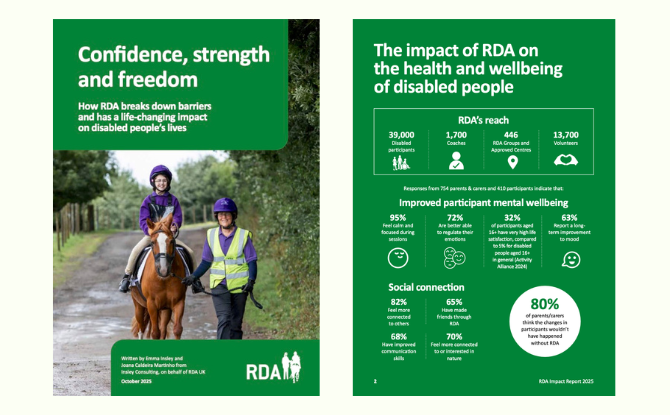
Many charities work incredibly hard to produce an impact report. Months of surveys, interviews, data analysis, report writing and design. And then it lands – sent to one or two funders, mentioned in a newsletter, filed away.
RDA did something different – and it is worth paying close attention to.
Why RDA needed more than anecdotes
RDA – Riding for the Disabled Association – harnesses the power of the human-horse connection to improve the health, wellbeing and confidence of disabled children and adults across the UK. Their network of nearly 450 Groups and Centres supports 39,000 participants every year.
They knew their work changed lives. But as Lee Heard, RDA UK’s Chief Operating Officer, explained, the fundraising team typically spoke anecdotally about their impact. And that gap between knowing your impact and being able to prove it was starting to matter in an increasingly competitive funding environment.
RDA was also trying to do something genuinely difficult: move beyond its traditional equine and agricultural funding base into the wider world of disability, health and education – new funders, new policy tables, new partners. But as Lee put it plainly: “The team didn’t feel confident to push through those doors without something really robust to talk about.”
Building the evidence base
Insley Consulting supported RDA UK to develop a Theory of Change, Monitoring and Evaluation Framework and Toolkit, and a comprehensive Impact Report – consulting with 1,290 people across surveys, interviews, focus groups and visits to four RDA Groups. The full report is available at rda.org.uk/impact.
The findings were striking:
- Our data showed increases in wellbeing, physical health, confidence, connections, and educational engagement across the network. RDA participants aged 16 and over report significantly higher life satisfaction than disabled people of the same age nationally.
- We reported stories of how the human-horse connection helped people to overcome grief and look to the future with purpose, children who are able to sit down at school for the first time after equine-assisted therapy, and how being part of the RDA community helped disabled people to overcome trauma and isolation.
- Over 80% of parents and carers said the changes they saw in participants wouldn’t have happened without RDA.
The data and stories were credible, specific and grounded in the real lives of disabled people.
But they were only the beginning.
Launching with intention
The report was published on the International Day of People with Disabilities – a deliberate choice that anchored the findings in a broader conversation about disabled people’s rights and inclusion. From there, it was shared at a British Equestrian Federation event, generating coverage in Horse & Hound magazine. Local Groups shared the findings in their own communities and a few months later, RDA was featured on BBC’s Countryfile.
The report became, as Lee described it, “the Bible that we refer to” – the evidence base sitting behind every conversation, every bid, every communication. Data and stories were regularly pulled into newsletters, website copy, and external messaging, with the explicit goal of shifting a long-standing organisational habit of talking about activities rather than the change those activities create.
What happened next
The Theory of Change gave staff a shared internal language and greater confidence in explaining why RDA matters. RDA used the evaluation to steward major funders, including People’s Postcode Lottery, who contribute over £1 million annually.
Since the report, RDA has seen its single largest donor come forward. Lee is careful not to draw a direct causal line – “we can’t necessarily create the correlation” – but he is clear that having robust data has changed the quality and pace of conversations with high-value funders. “Conversations are moving on quicker now that we can really discuss our impact.”
For local Groups, Insley Consulting developed an interactive Power BI impact dashboard – putting the evidence in the hands of the people closest to the work. Scropton RDA in the West Midlands used the data in a successful National Lottery Community Fund bid – and were featured on the Chris Evans Breakfast Show as part of National Lottery Open Week.
Opening new doors
The report has also helped RDA become a credible partner in national conversations in the disability sport sector that they hadn’t previously been part of – enabling them to make the case for disabled people’s inclusion in sport and physical activity with confidence and data behind them.
When the government opened a consultation on SEND reforms, RDA had the evidence base to respond with authority – and to equip local Groups to put forward their own submissions and engage their MPs directly through open stable days. “All the responses we’re working through, the data we’re calling on is all coming out of the impact report,” Lee reflected.
This is what happens when you treat impact and evaluation as a strategic asset, not a reporting exercise.
A different way to think about evaluation
For RDA, the report was critical to the strategic positioning of the federation. The evidence became the vehicle for a strategic pivot: away from a narrow funding base, into the wider world of disability, health and education. It opened doors into policy conversations, relationships with funders and partners who needed to see rigorous data before taking RDA seriously.
As Lee put it: “If you want to prove a concept of where you want to move the organisation, having a Theory of Change to test and a report to prove impact is really beneficial.”
Done well, a coordinated impact and evaluation report creates sustained momentum rather than a one-off moment. It shifts perceptions, builds new relationships and earns the kind of credibility that is hard to manufacture any other way.
At Insley Consulting, we help charities to measure and demonstrate their impact – and think carefully about how to communicate their findings for maximum effect. If your organisation would benefit from telling your impact story, we’d love to have a conversation.

Emma Insley
FOUNDER & LEAD CONSULTANT
Emma has first-hand experience of the thrills and terrors of charity leadership. Dedicated to the non-profit sector for 30 years, Emma has both depth and breadth of experience as a CEO, Consultant, Trustee and Chair, Fundraiser and Grants Assessor.
TALK TO US